



Congress is considering legislation to overhaul how electric transmission lines are planned and permitted, and investor-owned utility opposition to those reforms is one of the biggest threats to that bill’s passage.
The legislation, the “Bipartisan American Affordability and Jobs Act of 2026” (BAAJA, for short) is sweeping: it would transform the federal permitting regime for every type of energy infrastructure, with massive ramifications for both renewable energy and fossil fuel infrastructure. It would change what presidential administrations can do with regard to already bestowed permits for energy infrastructure. It would make it easier specifically to build geothermal energy. It would change how data centers are charged for electricity.
Many of those permitting changes, for better or worse, are policies which utilities have supported for years.
But the bill would also reform the planning and development of transmission lines, and that is expected to draw intense - if not always public - opposition from utilities.
Utility lobbying could result in a weakening of transmission reform titles, leaving a husk of a BAAJA that does less to make the electric grid more affordable and reliable, and less polluting.
Before getting into why, and how, monopoly utilities are likely to oppose the transmission reforms in BAAJA, let’s talk about what those reforms would do:
BAAJA’s Transmission Reforms
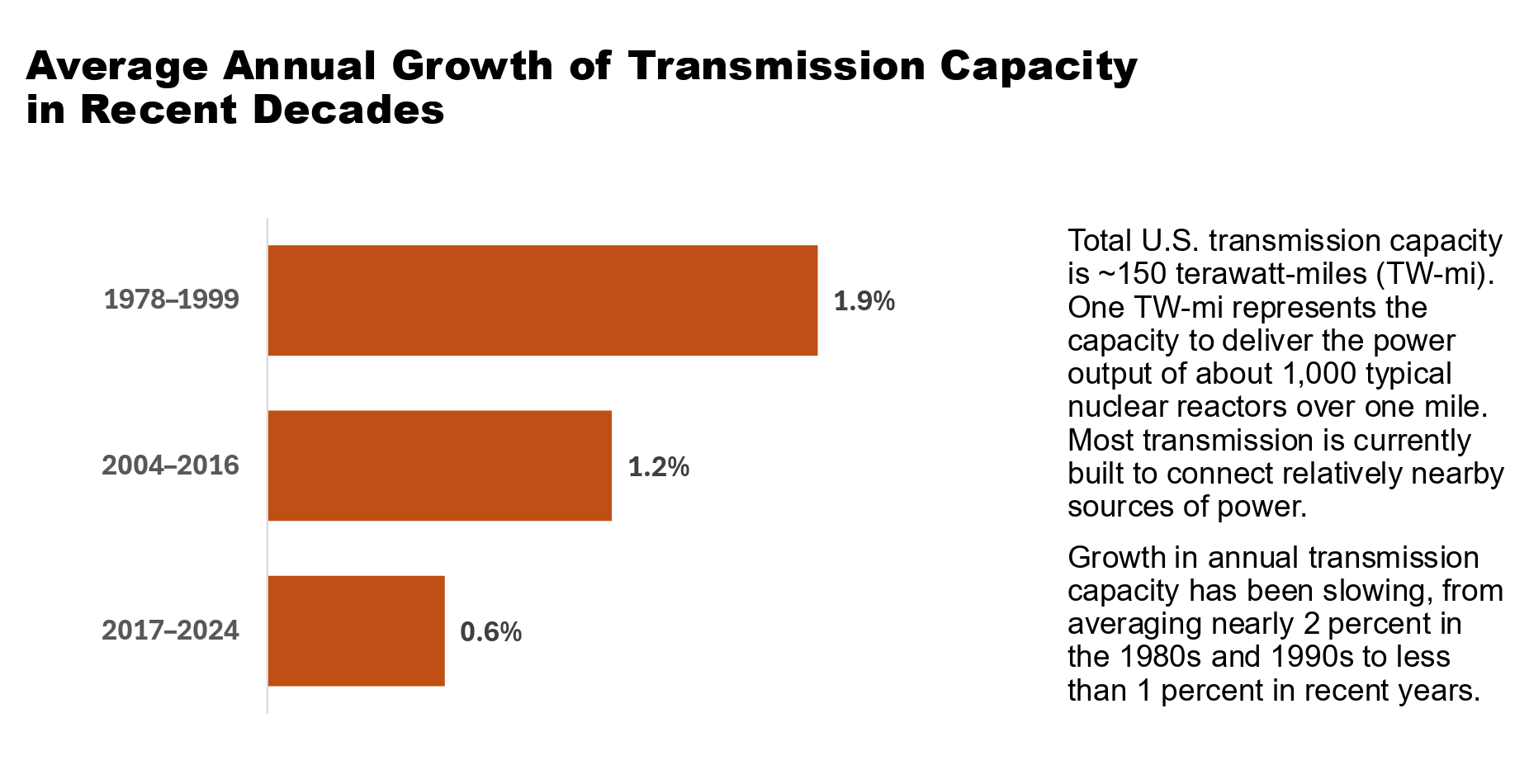
The premise of BAAJA’s transmission reforms is that in recent decades, development of high-voltage, long-range transmission lines in the United States has ground to a virtual standstill.
That’s a big problem: regional and inter-regional transmission lines ensure that when a region in one part of the country doesn’t have enough electric supply to meet demand, it can import electricity from another region that might have some to spare. Even absent shortages, if electricity in one region is very expensive, that region can import some from another region where electricity is cheaper.
Transmission holds value that is agnostic to energy generation types, but it’s especially important for wind and solar energy. Those resources are often most plentiful many miles from cities where people live; transmission lines are needed to bring that cheap and clean electricity to users.
Here are some of the biggest ways BAAJA would jumpstart transmission development:
Currently, a transmission line has to be permitted by each state it crosses. BAAJA says that if a state says no on a high-voltage line, or is taking too long to decide, federal regulators at FERC can step in and approve the line if they find that it benefits the public.
Currently, the hardest transmission to build is inter-regional transmission: lines that cross between the country’s various grid regions. “Hardest” is an understatement: we basically build none of this. BAAJA would require each grid region to develop common planning methodologies with its neighbors, and to plan lines together.
Currently, every grid region uses different ways of determining how to allocate the costs and benefits of transmission. BAAJA sets federal standards for how regions should do that.
BAAJA would require that investor-owned utilities use advanced transmission technologies on all new lines, including the best available conductor technology, and to make upgrades if the benefits outweigh the costs.
Currently, utilities are building plenty of local, lower-voltage transmission lines, and those lines get far less scrutiny than regional ones. BAAJA would allow state regulators to refer a utility’s local transmission planning to a joint FERC-state team for investigation under two scenarios. If the investigation found the utility wasn’t picking the more efficient or cost-effective local projects, or it was getting in the way of regional planning, FERC could cut the profit rate the utility earns on those local lines and fine it up to $5 million per project, with the fine paid to the state.
BAAJA would ban federal rights of first refusal that would allow utilities “first dibs” to build interregional transmission lines, allowing competitors to bid for the lines.
Why Utilities Oppose Transmission Reforms
As this substack obligatorily says at least once per post: utilities make money by building stuff. And utilities build transmission. So if the goal of BAAJA’s reforms is to result in more transmission being built, I’d understand if any reader is now asking themself: why on earth would utilities oppose legislation that enables more transmission to be built?
Well, long-distance lines create value because they let cheaper power from one region displace more expensive power plants in another region. And who owns those power plants? A utility. So even if one company, possibly even a utility company, is getting to profit by building a new transmission line, another utility may be losing money from the new line, if it undercuts the value of its own power plants.
A 2025 paper, Power Flows: Transmission Lines, Allocative Efficiency, and Corporate Profits, by Catherine Hausman, documented this perverse incentive in a vivid case study. Hausman estimated that better grid integration would have cut the net revenues for two of Entergy’s subsidiaries by a whopping $850 million combined in just one year, 2022.
Utilities aren’t antagonistic to all types of transmission. Many utilities have been thrilled to build local transmission. These are lower voltage, shorter lines that utilities build within their service territory fiefdoms. They do not threaten the profitability of the utility’s other assets, or the utility wouldn’t propose them.
Ari Peskoe’s seminal paper, Is the Utility Transmission Syndicate Forever?, showed how utilities have preferred to build local transmission lines, subverting efforts in RTOs to plan regional ones.
Of all the utilities, those in the Southeast, most of which are not members of a regional transmission organization, have done the most to block transmission, and are likely to be the ones who will do the most intensive lobbying against the transmission titles of BAAJA, based on their track record.1
EPI published a tour de force a few years ago detailing some of the things Southeastern utilities have done to kill regional transmission planning. Here are some highlights:
Entergy throwing sand into MISO’s gears
Entergy is the poster child for how utilities can slow down regional transmission planning within the regional transmission organizations (RTOs). In 2011, Entergy committed to join an RTO while facing a DOJ antitrust investigation into its alleged anti-competitive transmission practices.
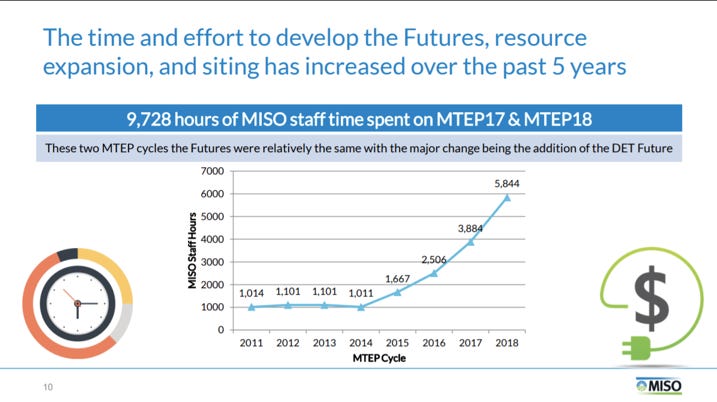
After Entergy joined MISO in 2013, MISO’s planning hours ballooned from 1,011 in 2014 to 5,844 in 2018.2 When MISO approved $21.8 billion in long-range lines in 2024, all of those lines went into the Midwest; no long-range lines went to MISO South, where they might outcompete Entergy’s plants, as Hausman’s paper showed.
What kinds of things did Entergy do to gum up MISO’s planning?
Records obtained by EPI showed that a former 17-year Entergy executive presented himself at MISO meetings as a “MISO South customer.” An Entergy Mississippi employee wrote that he acted “on Entergy Mississippi’s behalf.”
Entergy also co-opted its state regulators to act on its behalf. Records obtained by EPI show Entergy coordinated with Mississippi PSC staff and the PSC’s outside consultants as Mississippi led pushback on MISO’s long-range planning.
When all that fails, Entergy had other tricks up its sleeve. In 2018 MISO selected NextEra to build Hartburg-Sabine, a 500 kV line in East Texas. Entergy Texas then backed SB 1938 at the Legislature, a 2019 Right of First Refusal law for incumbents that blocked NextEra from building the line. MISO later canceled the line.3
Entergy has objected to Southern Spirit, a proposed high-voltage direct-current line that would connect Texas’s islanded electric grid to the rest of the Southeast. It’s the exact kind of line that could have been critical to alleviate the devastating impacts of Winter Storm Uri, had it been built. Entergy told Mississippi regulators in 2023 the line would threaten its gas plants.
NextEra spent millions, acted covertly, against Canada-New England transmission line
NextEra Energy’s track record shows how even utilities who build a lot of transmission can oppose lines that threaten its own assets.
NextEra contributed over $20 million to “Mainers for Local Power,” the group that spent $24.5 million in support of a 2021 ballot referendum to ban a transmission line to carry hydropower from Canada to New England. The initiative passed; courts later ruled that it could not be applied retroactively.
That’s not all NextEra did, though. Long before its more public spending to kill the line, NextEra was pulling strings in Maine. A state investigation later revealed that NextEra covertly funded “Stop the Corridor,” a group that backed an earlier version of the initiative and was later fined for failing to properly register as a ballot committee. Had it properly registered, NextEra would have been revealed as a donor, according to a state investigation. NextEra also routed a $150,000 contribution through a shell corporation to the Maine Democratic Party in 2018.
The shell company, “Alpine Initiatives,” did not list NextEra as a donor, but it did list The Hawthorn Group, a notorious political consulting firm often hired by utilities. State investigations revealed NextEra as Hawthorn’s client.
Southern Company’s relentless obstruction of transmission
Beneath those headline-grabbing incidents, utilities seek to undermine transmission development in an endless parade of more quotidian regulatory maneuvers.
In 2018, Southern Company responded to a planned DOE transmission congestion study by calling economic congestion “not particularly relevant” to the Southeastern electricity system, and said that DOE “should refrain from pursuing project-specific studies” and national interest electric transmission corridors, federal transmission permitting backstop authority that FERC has held for some prescribed parts of the country, and never used. (BAAJA expands this backstop authority to the whole nation, excluding lines within ERCOT.)
DOE didn’t listen: earlier this year it estimated the value of congestion between the Southeast SERTP region and its neighbors, finding an average cost of $8.14/MWh from 2016 to 2023.
When FERC proposed what would become Order 1920 in 2022 to help improve transmission planning, Southern argued that “a minimum set of benefits should not be required.”
Southern also lobbied FERC for a federal reinstatement of the same Right of First Refusal, giving it first dibs before any rivals could bid on a new line; BAAJA now proposes banning that.
Southern also has been a part of planning processes in its region, SERTP, that seem designed to fail. SERTP’s utilities studied three 500 kV lines in 2025. . It dismissed all three because they didn’t replace a local project already planned by the utilities.
That result is typical. In fact, SERTP’s transmission so-called planning process has never chosen a regional transmission line over its utilities’ local projects. Not once.
After their own planning processes reject new regional or interregional transmission, utilities can call the empty result proof that they’re doing everything right. Southern told FERC in 2022 that SERTP’s failure to find better regional projects “validates the robustness and thoroughness” of SERTP.
Those chickens have come home to roost: During Winter Storm Elliott in December 2022, the Southeast region had blackouts while plentiful wind energy was curtailed in neighboring regions. DOE said insufficient transmission limited sharing with neighbors and that more of it could have reduced the blackouts’ duration and magnitude.
Southern’s regulatory advocacy at FERC is backed by one of the largest lobbying and political machines in the sector.
Southern reported spending $191 million in activities related to political influence from 2015 through 2020 in annual filings to FERC, far more than any utility other than NextEra during that time, according to data EPI compiled. From 2020 through 2025, Southern spent over $60 million on federal lobbying, according to OpenSecrets - a total which would not include the armada of lawyers it pays to advocate for its interests at FERC.
What will the utilities do on BAAJA?
A hallmark of some of these stories is utilities’ use of covert action and third-parties to kill transmission lines. That makes sense. It’s a lot more attractive for a policymaker or RTO to accept an argument to slow down or block a line because some conservationists don’t want it, as in the NextEra/Maine case, or because Mississippi regulators are opposed, as in the Entergy/MISO example, than it is to listen to a utility saying “this development will hurt our profits.”
That dynamic is even more intense right now, with utilities having become a massive political punching bag in recent years in the states and in D.C. due to the rate increases they have foisted on customers in recent years. Those customers then get angry, and they vote, and politicians have taken notice.
That’s all to say that I don’t expect Duke, Entergy, NextEra, Southern Company, or their trade association the Edison Electric Institute, to outright oppose BAAJA; and in fact Duke Energy’s statement provided an impressive answer to the question “how many words can you use to say absolutely nothing at all.”
Instead, I expect these companies will try to find any means possible to act privately to subvert the transmission titles of BAAJA.
There are some obvious avenues through which they might try to influence the bill. Brett Guthrie, the Republican congressman who chairs the House Energy & Commerce Committee, has said that “‘we absolutely would love to see changes to the’ grid section of the Senate’s bipartisan permitting bill,” Punchbowl reported.
Guthrie and his PAC have taken over $150,000 from utility PACs in this election cycle, including Entergy, Dominion, Duke, NextEra, Southern Company, and the Edison Electric Institute.
But the utilities’ track record shows how they may also try to route their advocacy through less obvious means, including IBEW, a labor union that’s traditionally advocated in lock-step with utilities’ profit interests, and other interests from across the political spectrum. EPI recently published a new tool that shows which utilities are members or funders of various D.C. trade associations and think tanks.
Policymakers and other Congress-watchers should be vigilant for anyone who might be carrying the utilities’ water for them, and understand that the utilities want to protect their profits, even when that means obstructing a 21st century grid.
AEP and Berkshire Hathaway Energy, utilities with assets in the Midwest, West, and Southwest, have both said they support BAAJA.
Entergy’s choice to join MISO in the first place, which created a significant transmission bottleneck to its own service territory, rather than SPP, with more transmission linkages, may have foretold what was to come.
The courts would later strike down that state law.
Yes! All this commentary about environmental groups killing things is entirely missing the bigger story. It's utilities...
This is as old as utilities asking to be regulated to protect them from the vagaries of competition. As for WSE in December 2022, transmission was not the issue. Failure to have major generators available and still in the midst or planned outages was the real reason. Oh, and then leaned on PJM and MISO to cover their errors. I have the receipts on that and they are available in two FERC dockets with complaints filed against PJM for their actions during the storm for exporting heavily off system among other errors to help the SE cover up those mistakes.